
Early Signs of Visible Intoxication
By the time a customer is stumbling, vomiting, slurring words or passed out at the bar, we are no longer talking about the early signs of visible intoxication.
That person may be far beyond the early warning signs.
Yet, too often, we read deposition testimony in alcohol liability cases where servers, bartenders, security personnel, barbacks and managers testify that they were watching for visible intoxication.
Then they are asked what signs they were looking for.
The answers are often the most obvious and extreme behaviors imaginable.
Visible Intoxication Is More Than Stumbling and Slurred Speech
We frequently see testimony that a patron did not “look drunk” because the person was not:
- Vomiting
- Stumbling
- Falling while walking
- Slurring words
- Sleeping at the bar
- Passed out
Those can certainly be signs that alcohol has affected someone.
But they are not necessarily early signs of visible intoxication.
Those are the signs almost anyone can recognize.
In less technical terms:
That’s plowed drunk.
By that point, the question isn’t whether the person has begun displaying subtle behavioral changes.
The signs may already be obvious.
Alcohol Servers Need to Recognize Earlier Signs
Alcohol service professionals should be trained to recognize more than the stereotypical image of a falling-down drunk.
Intoxication can develop over time.
Behavior can change.
Judgment can change.
Coordination can change.
Speech can change.
A customer’s interactions with employees and other patrons can change.
The important point is that employees need training that helps them recognize changes before the most extreme signs appear.
What Are Early Signs of Visible Intoxication?
Depending on the individual and circumstances, potential observations may involve changes in:
- Speech
- Volume
- Behavior
- Judgment
- Coordination
- Balance
- Inhibitions
- Mood
- Attention
- Reactions
- Social interaction
- Drinking behavior
One observation by itself does not necessarily establish that someone is intoxicated.
That distinction matters.
However, a combination of observable changes may provide employees with information they should recognize and evaluate according to their training and the establishment’s alcohol-service procedures.
Alcohol Server Training Matters
Telling employees to “watch for intoxication” isn’t much of a training program.
What are they supposed to watch for?
That’s the question.
Restaurants and bars need alcohol-service training that gives employees useful information about what they may actually observe during service.
Employees also need to understand what the establishment expects them to do when warning signs appear.
That may involve notifying a manager, slowing or stopping alcohol service, documenting an incident, or following other established procedures.
The exact requirements can vary by establishment and jurisdiction.
Visible Intoxication in Alcohol Liability Cases
After a serious alcohol-related incident, attorneys may need to reconstruct what happened inside the restaurant or bar.
Questions may include:
How long was the patron there?
What did the patron order?
How many alcoholic beverages were served?
Who served them?
What did employees observe?
Did the patron’s behavior change?
Did anyone notify management?
What training had the employees received?
What did the establishment’s policies require?
And perhaps most importantly:
What signs of visible intoxication had employees actually been trained to recognize?
What We See in Deposition Testimony
This is where restaurant and bar industry experience becomes important.
In alcohol liability cases, we routinely review deposition testimony from bartenders, servers, managers, security personnel and other employees.
Someone may testify that they were trained to identify intoxicated customers.
But that answer leads to another question:
What did that training actually teach them?
If an employee can identify only vomiting, falling, slurred speech and unconsciousness, that testimony may provide important information about the scope of the training they received and understood.
There is a difference between recognizing an obviously impaired person and recognizing early signs of visible intoxication.
Dram Shop Expert Witness Analysis
A dram shop expert witness may examine the restaurant or bar’s alcohol-service operation before an alcohol-related incident.
That analysis may include:
- Alcohol-server training
- Signs of visible intoxication
- Employee testimony
- Management testimony
- Alcohol-service policies
- Point-of-sale records
- Receipts
- Surveillance video
- Incident reports
- Security practices
- Management procedures
- Applicable restaurant and bar industry standards
The purpose is to examine what employees were trained to recognize, what they observed and how the establishment responded.
Don’t Wait for “Plowed Drunk”
If your definition of visible intoxication begins when someone is vomiting, stumbling across the restaurant or passed out at the bar, you’ve already skipped over an important part of the story.
The earlier behavior matters.
The changes matter.
The training matters.
And in an alcohol liability case, the testimony about what employees were actually watching for can matter.
Don’t just ask whether employees were trained to recognize intoxication.
Ask them what they were trained to recognize.
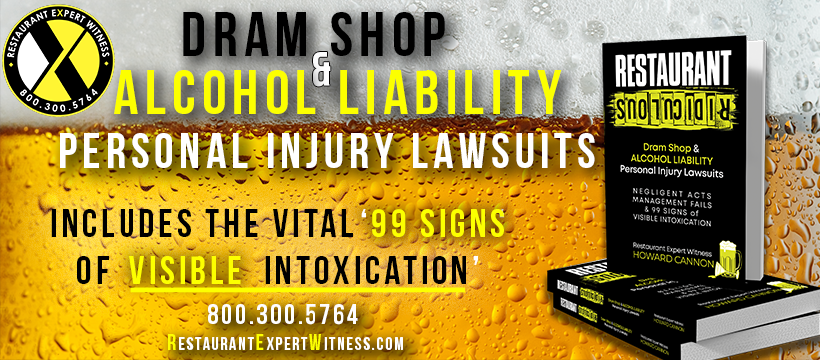
That’s why we wrote a book on the 99 Signs of Visible Intoxication that was the #1 Release in Personal Injury Law on Amazon when it came out.
We call it ‘Restaurant Ridiculous‘ and it includes a list of the 99 Signs of Visible Intoxication, along with additional information that is critical to know in a alcohol liability or dram shop case.
Do YOU Have a Restaurant or Bar Alcohol Liability Case?
There are many restaurant and bar industry standards that could be critical to your case – and the highly sought after expertise of Restaurant Expert Witness could be the factor that secures a victory in your case.
Call us at 800.300.5764 today for a FREE No Obligation Initial Consultation! Or, feel free to submit an inquiry using our Contact Form.
To find out more about us and what makes Restaurant Expert Witness Howard Cannon and his team experts in the restaurant and bar industry, watch a video here or explore our website here!